For commercial property managers
Every inspection your buildings owe.
Proven.
Backflow, sprinklers, alarms, elevators, hoods, generators — the law schedules them, and so does Muniment. Add your equipment; the due dates, code citations, reminders, vendor dispatch, and certificates take care of themselves.
No demo call. No implementation project. A 10-building portfolio is live in under 15 minutes.
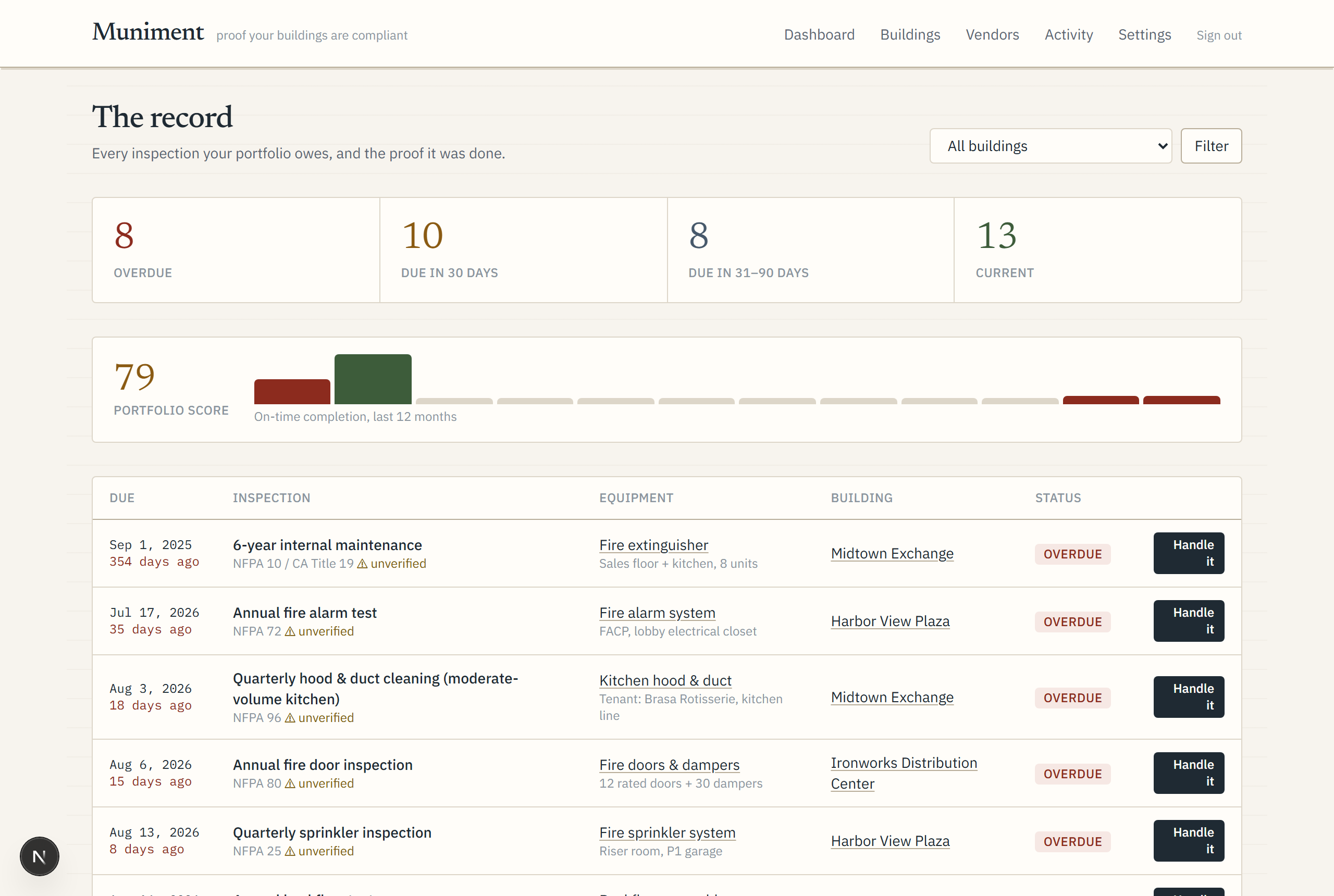
The actual product, sample data — not a mockup
The product knows the code.
You say what the equipment is — a sprinkler riser, a kitchen hood, an extinguisher made in 2015. Muniment answers with the schedule and the citation. It never asks you how often.
Browse the full California catalog, free →Every due item has a Handle it button.
One click dispatches a vendor with a verified license and unexpired insurance. They accept, schedule, and upload the certificate from their phone. Lapsed insurance? They can't be dispatched at all.
Proof, per asset, forever.
Each piece of equipment carries its own record, certificate history, and a QR tag on the wall. An inspector scans it and sees the proof. The owner gets a one-click PDF. A muniment is a document that defends your claim — that's the product.
The difference that outlasts every feature
Your compliance record should outlive your contractor.
And your ownership of the building.
Inspection software is built for the people who do the inspecting. Their model runs customer → site → asset → service → report, and you are the recipient of the PDFs. So the history of your buildings lives in a fire-protection company’s account, under their login. Change contractor and it walks out with them. Nobody says this out loud, and every manager who has switched has felt it.
Muniment is the other side of that arrangement. The record is yours: what you owed, the code section behind every date, who you made responsible, what they did, and the certificate that proves it. Contractors come and go through it. So do buildings. The record is the thing that stays, and everything below is what that means when something actually happens.
You fire your fire-protection company
Every open job moves to the new contractor in one action. Each gets a fresh private link; the old links stop working and tell the outgoing company why, by name. Everything they already completed stays on your record.
You sell the building
It leaves your portfolio and your plan's building count, and raises no more reminders — then keeps every inspection, certificate and decision it earned while you held it, still readable and still in your export, marked as no longer managed.
Somebody records the wrong thing
Reverse it. The correction carries a reason and a name, the schedule repairs itself, and both the original entry and the reversal stay on the log. Nothing is ever silently edited — by anyone, including us.
An inspection genuinely does not apply
Set it aside with a reason rather than deleting it. It stops counting as owed, and it appears in the owner packet as a decision somebody made, not as work that quietly vanished.
A certificate fails to upload
The visit is still recorded. The asset shows “no proof attached” and your contractor is asked for the file again — because a missing scan is a weaker record, and a lost visit is no record at all.
You cancel your subscription
Billing stops. The record does not. Everything stays readable and exportable for as long as you need it, because a compliance history you can no longer reach would be the one unforgivable thing this product could do.
Which is why every plan exports everything, and why one button produces an evidence pack for an insurer or a lawyer: what was overdue on the day, every decision in the period and who made it, and every certificate filed. A contractor’s scan log can show that somebody attended. It cannot show what you knew, when you knew it, or what you did about it. That is the document you need eighteen months later, about a building you may not even own any more.
Built for the week you actually have.
The calendar is table stakes. What costs you time is everything around it — the vendor who went quiet, the quote buried in an inbox, the budget meeting, the owner who wants proof. Each of these is in the product today.
The chase, on one button
A dispatched job that sits unanswered for five days surfaces on your dashboard with a Resend button — same link the vendor already has, so the email in their inbox keeps working. Chasing contractors stops being a Tuesday-morning inbox dig.
A front door for money
Every repair quote lands in one inbox: what's waiting on your yes, with dollar totals, and what you already decided — signed, timestamped, on the record. A quote that arrives during your vacation is still there when you get back.
Insurance watched for you
A contractor whose certificate of insurance lapses within 30 days — while they hold open work — is flagged on your dashboard before it becomes a blocked dispatch. Expired insurance can't be dispatched at all.
Next year's budget, priced
Muniment already knows every inspection your portfolio owes and when. Put your real prices on ~20 kinds of work and it prices all of next year — by month, by building — and exports straight into the operating budget.
Owner packets & evidence packs
One PDF for the owner covering the whole portfolio, overdue items first. One document for an insurer or lawyer: what was overdue on the day, every decision and who made it, every certificate filed. Any date window.
Named cover, not a shared inbox
One person owns each building and one covers for them. Reminders go to the owner; once something is actually overdue, the backup and the account owner hear too. Holidays stop being a compliance gap.
A record that survives mistakes
Marked the wrong thing complete? Reverse it — the correction is recorded with a reason and a name, the schedule repairs itself, and nothing is ever silently edited. The log is append-only for everyone, including us.
Import your real history
A last-service date per asset anchors each cadence to work already done, so you start from your actual position rather than a wall of day-one alarms for buildings you have been maintaining for years.
Show an inspector, on the spot
A public read-only page per building — every asset, its next date, its last certificate — plus a QR tag on the equipment itself. The fire marshal reads the proof without you logging into anything.
The part everyone else charges you for
Paste the spreadsheet you already have.
Including the mess in it.
Not a template you have to conform to first — the export your current system produced, with its American dates, its blank cells and its one misspelt building. Muniment reads it, tells you precisely what it could not read, and never silently drops a row.
building,equipment,location,last_service
Grand Lake Shops,Kitchen hood,Suite 110,3/15/2026
Grand Lake Shops,Sprinkler,Riser room,15-Mar-2026
Fruitvale Retai,Fire extinguisher,Corridor,
Grand Lake Shops,Sprinkler,Riser room,3/15/2026
- ✓ 3/15/2026 and 15-Mar-2026 both read as 15 March — the sprinkler’s next quarterly is dated from it, not from today
- ⚠︎ No cooking volume given, so nothing can be scheduled for the hood — add high, moderate or low
- ✕ No building called “Fruitvale Retai” — add it first, or fix the spelling
- · The repeated riser is already on the record and was left alone
You see all of that before anything is saved. The rows that need attention come back as a file in the shape you pasted, so you fix the column and paste it again. Twenty-eight buildings and a hundred and forty assets take about ten seconds — and the inspections that come out the other side each carry the code section behind them.
The alternative is a demo call, an implementation, and a spreadsheet anyway.
Compliance platforms built for enterprises:
”Request a demo.” ”Talk to sales.” Pricing on application. Weeks of onboarding before your first reminder fires.
Muniment:
Download the spreadsheet template, import your buildings, add equipment, and the calendar exists — citations attached, reminders armed. Under 15 minutes, self-serve, price on the pricing page.
Managing 40+ buildings and want a human involved anyway? The managed service add-on puts Muniment’s dispatch desk between you and every vendor — or just email a founder and we’ll walk your portfolio in together.
Early access
We’re new. That’s your leverage.
Muniment launched in 2026 and we’d rather tell you that than rent a wall of stock-photo testimonials. Founding customers get their first year at half price, a direct line to the people building the product, and a say in what ships next. When we do publish numbers, they’ll be real ones.
Become a founding customerFair questions.
How do I know your inspection schedules are right?
Every rule carries its code citation and a plain-English explanation, and the whole catalog is published openly on our California requirements page. Where a frequency hasn't been verified against the current code text, we mark it — visibly, in the product and on that page — instead of pretending. Your AHJ always has final say, and the product says that too.
What happens to my data if I downgrade or leave?
Nothing is ever deleted. Downgrading past your plan's building count makes the newest buildings read-only until the plan fits — the records, certificates, and history all stay. Export is yours anytime.
Do my vendors need accounts?
No. A dispatched vendor gets a private link — like a document-signing link — to accept, schedule, and upload the certificate from their phone. One link, one job.
Is this legal advice?
No. Muniment tracks inspection schedules based on published code references. It is not legal advice, and the authority having jurisdiction has final say.
We show our work.
Every rule in Muniment carries its code citation and a plain-English explanation. Where a frequency hasn’t been verified against the current published text for your jurisdiction, we mark it ⚠︎ unverified instead of pretending. Your fire marshal has the final say — our job is to make sure you never meet them unprepared.